
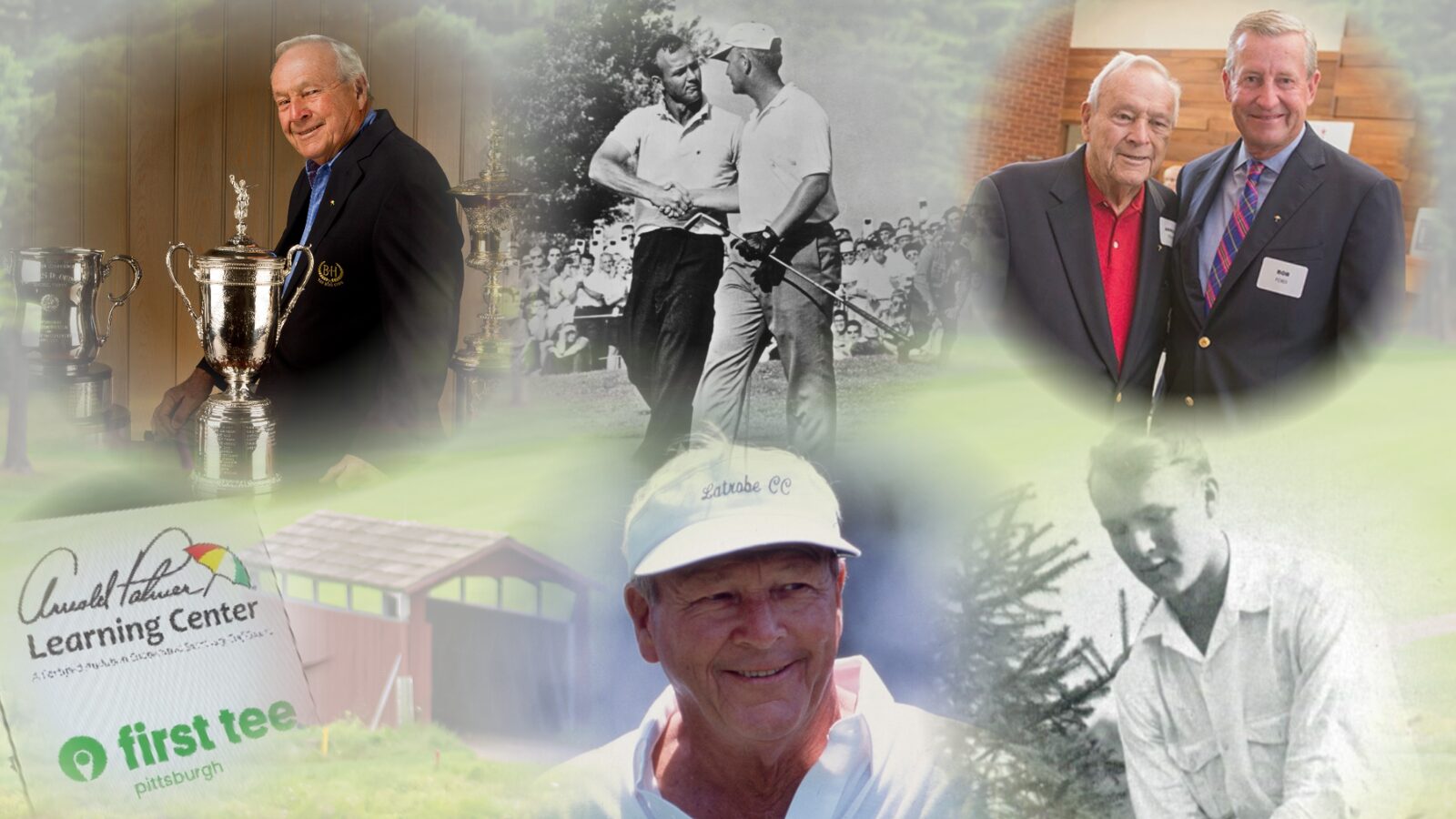
The first time that Bob Ford stood on the first tee at Oakmont Country Club alongside his playing partner, Arnold Palmer, there was one feeling of emotion that superseded all others.
“I was petrified,” recalls Ford, the former head golf professional at Oakmont Country Club who himself is one of the region’s most renowned figures in the game. “All of us (who have played with Palmer) have been. He was a phenomenal guy. Just to be in his presence, I was in awe.”
Ford, who at the time was a mid-20’s assistant professional under Lew Worsham, had his nerves that spring day in 1978 eventually calm, as he and Palmer traversed the terrain of Oakmont Country Club in advance of the PGA Championship. It was then that Ford began to understand Palmer the person, having already been educated on Palmer the golf icon.
“He was a man’s man,” says Ford, who possesses a vault’s worth of memories of and sayings by Palmer. “He was somebody you wanted to have a beer with, somebody you wanted to hang out with. He had no airs about him at all. He just wanted to be one of the guys and couldn’t have been a more genuine, authentic person.”
Palmer died from heart complications on September 25, 2016, just 15 days after his 87th birthday. But a decade later, Palmer’s impact, reach and legacy remain as profound as they were on the cool October morning a decade ago, when his life was celebrated at Saint Vincent College in his hometown of Latrobe.
“In his era, nobody had a bigger impact on the game and the burst of the game in the 1960s than Arnold,” says Ford. “He was the ambassador that everybody wanted to be like... His history is never going to be repeated.”
The sheer magnitude of Palmer’s influence almost incomprehensible.
First, there was the golfer.
While many of Palmer’s on-course accomplishments have been surpassed, the man who stood just 5-foot-10 remains a giant in the sport.
His 62 PGA Tour wins are still top five all-time, with Sam Snead, Tiger Woods, Jack Nicklaus and Ben Hogan being the only men to win more.
Nicklaus and Woods are the only players to have won the Masters more than Palmer’s four victories, with his last coming in 1964 — his final major championship triumph.
He won the 1960 U.S. Open and, the following two years, won consecutive Open Championships.
Palmer was Sports Illustrated’s Sportsman of the Year in 1960, won the Bob Jones Award in 1971, the Old Tom Morris Award in 1983, the PGA Tour Lifetime Achievement Award in 1998 and the Payne Stewart Award in 2000. He was inducted into the World Golf Hall of Fame in 1974 and was a member of the inaugural class in the Western Pennsylvania Golf Hall of Fame in 2013.
His bold style of play and success during the early days of television made him one of sports’ most recognizable and iconic figures. It brought out droves of fans who labelled themselves part of ‘Arnie’s Army,’ and, perhaps above all else, it shifted the public perception of golf entirely.
“Arnold’s place in history will be as the man who took golf from being a game for the few to a sport for the masses,” Nicklaus told the USGA following his death. “He was the catalyst who made that happen.”
While entire books can — and have — been written about Palmer’s accomplishments as a player, his work outside of the course is perhaps even greater and more intriguing.
Quite simply, the man seemingly had a hand in just about everything.
In the golf business, he purchased Latrobe Country Club, where his father, Deacon, served as course superintendent and which now exists as a standing tribute to Palmer's life and feats. He owned Bay Hill Club and Lodge in Orlando, Florida, the site of the PGA Tour’s Arnold Palmer Invitational. He even negotiated a deal that brought the first golf course to the People’s Republic of China, leading to the creation of his golf course design company, which has crafted over 300 golf courses worldwide.
He helped found The Golf Channel, got into the car dealership industry, began to mass produce Arnold Palmer beverages (a now famous combination of iced tea and lemonade).
“There was a young kid in the golf program at the Breakers Hotel (in Palm Beach) and we brought up the name Arnold Palmer to him,” Ford says. “The kid said, ‘is that the guy on the iced tea can?’ That kept him living in perpetuity. It was a big deal for him, and it was the biggest financial deal he ever had.
“He was a great spokesman for any company. And he treated everybody so genuinely. Everybody wanted a piece of him.”
Palmer became a certified pilot and, on his 70th birthday, had an airport in his hometown of Latrobe named after him. He was approached numerous times about running for political office but declined.
Palmer received the Presidential Medal of Freedom in 2004, becoming the first golfer to receive the honor, and was granted the Congressional Gold Medal in 2009, joining just five other athletes to be bestowed that recognition.
Perhaps most economically significant, his handshake deal with now-renowned sports agent and marketing representative Mark McCormack, becoming his first client and leading to the start of IMG, is largely viewed as the birth of the multi-billion-dollar sports marketing and athlete representation industry that we know today.
As his net worth crept towards a billion dollars, he and his wife, Winnie, turned into philanthropic heavyweights.
Their generous gift to the Arnold Palmer Hospital for Children in Orlando has resulted in the facility being considered among the finest in the world. The Winnie Palmer Hospital for Women and Babies has served as a catalyst in central Florida, and was even the birthplace of Tiger Woods’ children.
The couple, through the Arnold and Winnie Palmer Foundation, founded a nature reserve in Western Pennsylvania, had numerous philanthropical initiatives in support of members of the military and helped grow the game of golf locally through donations and support of golf education facilities, such as the Arnold Palmer Learning Center at the Bob O’Connor Golf Course in Schenley Park.
In the mid-90’s, Ford and Tri-State PGA executive director Dennis Darak approached Palmer about running a competition between the Tri-State professionals and the WPGA’s amateur golfers. The unique event, named the Palmer Cup, has been held for over three decades now at Latrobe Country Club. It was Palmer who requested that the competition be held annually at his club.
In the 1999 Palmer Cup, Ford matched up against amateur legend and nine-time WPGA Amateur champion Sean Knapp, and promptly defeated him in 14 holes. At the time, Ford was 9-under for his round. His playing partner and opponent wanted him to continue playing in an attempt to break Palmer’s course record of 60.
“They said, you’re going to break Arnold’s record,” recalls Ford, noting that Palmer was playing in the group in front of him at the time. “I had seen Arnie’s record scorecard in the clubhouse in the morning, for some crazy reason.
“I put my ball in my pocket and said, ‘no, let’s go have a beer.’ I wanted nothing to do with breaking Arnold’s record.”
Ford’s reverence towards Palmer is indicative of how so many felt during Palmer’s life and still feel today. The respect that he received, but seemed to not demand, is telling. Palmer’s reciprocation of that respect to others remains striking to Ford to this day.
In 1983, for instance, Palmer asked Ford if he could be added to a group for a practice round prior to the U.S. Open at Oakmont. With the group already full, Ford called the USGA for guidance on the possibility of adding a fifth player.
“The boss at the USGA said, ‘uh, yeah, just don’t hold anyone up and it’s okay,’” says Ford, with a laugh. “He knew Arnold was in the crew.
“Arnold loved the local guys from Western Pennsylvania and wanted to play with them. Any time I qualified for a major, which wasn’t often, he would ask to play with me. He was interested in what happened locally and would ask what was going on with the West Penn or how things were around Oakmont. He was curious.”
Ford’s stories and remembrances are merely the tip of an iceberg when it comes to the legacy crafted by Palmer in the Western Pennsylvania golf scene. In every corner of the region, stories still abound, detailing quick meetings, handshakes, photos and, for the lucky few, a day on the course with the man affectionally referred to as ‘The King.’
Ford becomes emotional when discussing the life of his friend. He regularly speaks during dinner after the Palmer Cup, sharing stories of the event’s namesake — some amusing and some more inspiring — while encouraging the region’s golfers to try to follow the path laid out by the most accomplished athlete to come out of Western Pennsylvania.
“‘There’s no one who played the role of Arnold Palmer better than Arnold Palmer,’” recites Ford, quoting a decade-old saying from Palmer’s obituary in TIME Magazine. “That’s a great line, huh?
“Arnold never had a bad day. That made him the envy of all of us.”
For media inquiries, please contact WPGA Director of Communications Josh Rowntree.